
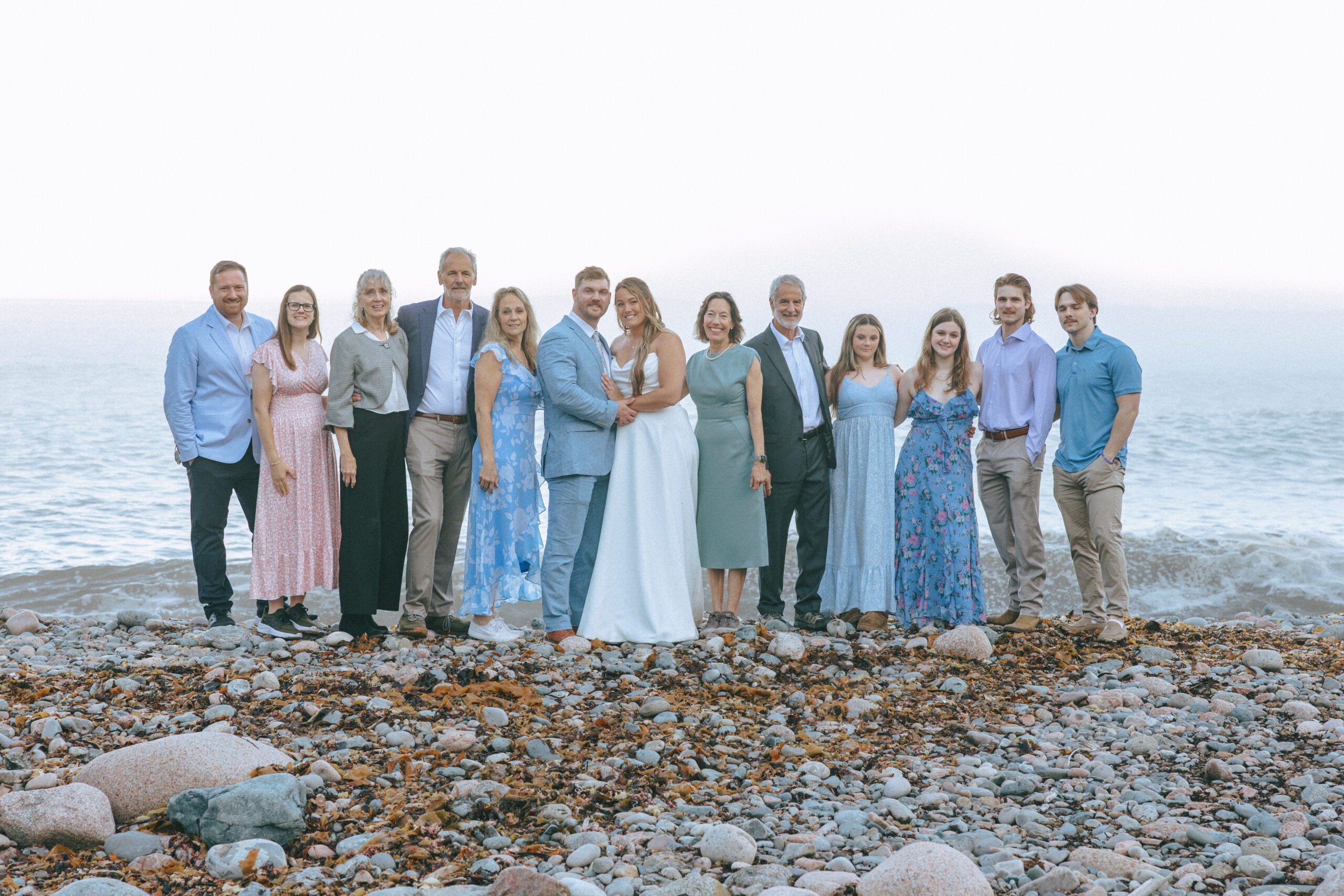


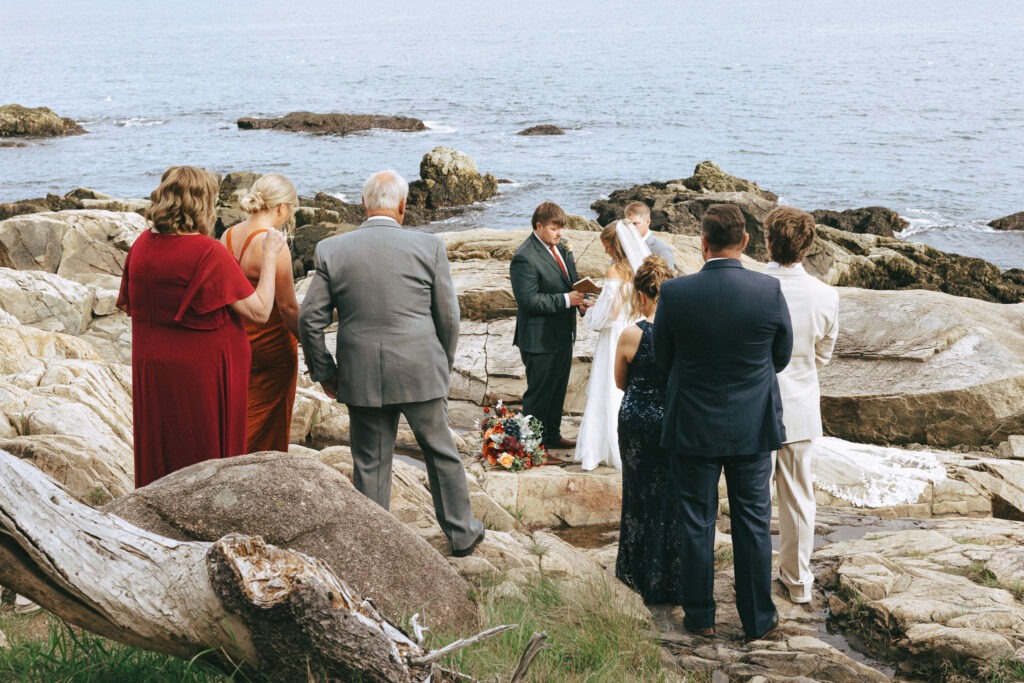
If you’re inviting guests to your Acadia elopement, I’m assuming they’re people you actually really want there. Parents, grandparents, siblings, best friends, kids, chosen family. Having those people with you can make the day feel even more meaningful.
But Acadia is not a traditional wedding venue, and sometimes that gets lost in the excitement of choosing beautiful locations.
There may not be a paved walkway. There may not be chairs. There may not be a bathroom nearby. Your guests could be walking over rocks, roots, gravel, granite, boardwalks, or stairs depending on where we go.
And if we’re planning for sunrise, they may be doing all of that before they’ve even had coffee.
None of this means you shouldn’t bring guests. It just means we need to think about their comfort and physical abilities when we’re building the day.
A location can be completely manageable for you and still be a rough experience for your parents or grandparents. That doesn’t mean we throw out the location. It usually means we figure out which parts of the day make sense for everyone and which parts are better saved for just the two of you.

What Should Guests Know Before Attending an Acadia National Park Elopement?
The biggest thing I want guests to understand is that they’re still going into a national park.
Even when a location looks easy in photos, the walk in may involve loose gravel, uneven granite, roots, stairs, inclines, or wet ground. A short walk in Acadia can feel very different from a short walk around your neighborhood.
You absolutely can still dress up. I just want people thinking about what happens between the parking lot and the ceremony location too.
Bring the nice shoes. Bring the jacket you don’t want in the photos. Bring the practical stuff and take it off when we’re ready.
It’s much easier to toss a jacket behind me for five minutes than it is to make someone stop being cold.
How I can help:
When we start narrowing down locations, I can give you a much more realistic picture of what getting there actually looks like—not just how far it is from the parking lot. I’ll help you understand the terrain, approximate walking time, stairs, exposure, and anything else your guests should know ahead of time.
How Much Walking Should Guests Expect During an Acadia Elopement?
When we’re planning with guests, I care less about the exact mileage and more about what the terrain looks like.
Half a mile on pavement and half a mile over roots, granite, and stairs are two completely different things.
Some guests may be perfectly comfortable walking a decent distance on flat ground but struggle with uneven surfaces. Someone else may be fine with rocks but have a hard time standing for twenty minutes without somewhere to sit.
That’s why I’d rather you give guests specific information instead of saying, “It’s only a short walk.”
Ask whether they’re comfortable with uneven terrain. Ask whether stairs are an issue. Ask whether they need somewhere to sit. Ask whether they can comfortably walk in the dark if we’re planning for sunrise.
The more specific we are, the easier it is to build a day that actually works for everyone.
How I can help:
Tell me what your guests can comfortably handle and I can build location options around that. I can also help you separate the day into shorter guest-friendly portions so no one feels like they need to keep up with you for hours.

What Shoes Should Guests Wear to an Acadia National Park Elopement?
Please encourage your guests to wear shoes they can actually walk in.
I have seen enough dress shoes, flimsy sandals, and brand-new footwear on rocky ground to know that this deserves its own section.
For most locations, I’d much rather see guests wearing sneakers, trail runners, or hiking shoes with decent traction while we’re moving around the park.
If someone wants heels, loafers, sandals, or something more formal for the ceremony, great. Bring them in a bag and change once we get there.
No one is going to remember that your mom wore sneakers for the walk in.
She will absolutely remember if she spent the entire ceremony worried about slipping.
How I can help:
Once we know where we’re going, I can tell you what kind of footwear makes sense for that location. I can also help you plan easy spots to change shoes before portraits so everyone can still wear what they want without navigating the park in it.
What Happens if It Rains During an Acadia National Park Elopement?
Rain changes more than the photos.
Wet granite can get very slippery, and a trail or rocky area that feels easy in dry conditions may be a completely different story after several hours of rain.
That matters a lot when we have guests with knee or hip issues, balance concerns, limited mobility, recent injuries, or anyone who just isn’t comfortable on uneven ground.
This is also why I may recommend tweaking a location depending on the weather.
It’s not me being dramatic about rain. It’s me looking at the group we actually have with us and deciding whether a location still makes sense.
Acadia has plenty of beautiful places. We do not need to destroy someone’s knee for one particular rock.
How I can help:
I’ll keep an eye on conditions as we get closer to your day and help adjust the plan if needed. I can build backup locations into your timeline ahead of time so a rainy morning doesn’t turn into a last-minute scramble.
How Windy and Cold Can Acadia Be During an Elopement?
Pretty windy. And sometimes much colder than people expect.
One of the biggest mistakes guests make is dressing for the temperature they saw in Bar Harbor instead of the conditions we may have along the coast or at a higher elevation.
Wind changes everything.
A 60-degree morning can feel great in town and chilly once you’re standing beside the ocean before sunrise.
I always recommend bringing layers. Sweaters, jackets, rain shells, blankets, extra socks, whatever makes sense for the season.
They can stay in the car if we don’t need them.
And if someone needs to wear a jacket during part of the ceremony because they’re freezing, that is completely fine. I would much rather photograph a comfortable human than someone silently counting the seconds until we leave.
How I can help:
I can help you plan around the time of day, season, and exposure of each location. I’ll also help you build extra time into the schedule so guests can grab layers, warm up, or head back to the car without throwing the whole timeline off.
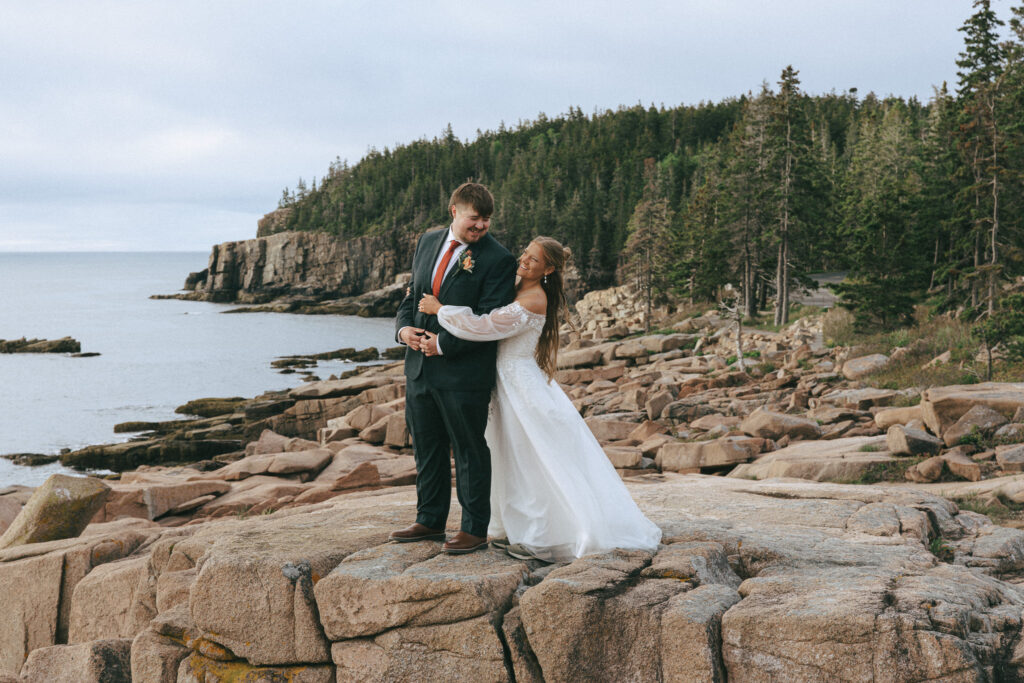
Is a Sunrise Acadia Elopement a Good Idea With Guests?
It can be.
I love sunrise in Acadia. The light is beautiful, some locations are much quieter, and the whole park feels different before most people are awake.
But sunrise with guests needs a little extra thought.
Depending on the time of year, your guests may be waking up hours earlier than normal, getting fully dressed, driving unfamiliar roads in the dark, finding parking, and walking to a location before the sun is up.
That might be no big deal for your best friend who hikes all the time.
It might be a lot for your grandfather who has balance issues and normally wakes up at eight.
There are plenty of ways around that.
Maybe everyone joins us for sunrise. Maybe we choose an easier sunrise location. Maybe you two start the day with me and meet your guests later for the ceremony or breakfast.
You don’t have to force every person into the same timeline.
How I can help:
I can help you decide whether sunrise makes sense for your specific group instead of treating it like an automatic yes or no. We can also split the morning so you get the quiet sunrise experience you want without asking every guest to wake up at an ungodly hour.
Is Acadia National Park Accessible for Elopement Guests?
Parts of it absolutely can be.
But accessibility in Acadia is very location-specific, and even within the same location you can have one area that works beautifully for someone with limited mobility and another area that does not.
That’s why I don’t love saying a location is simply “accessible” without talking about the actual person using it.
Someone who uses a cane may have different needs from someone using a wheelchair. Someone who has a bad knee may do fine on a flat gravel path and really struggle with stairs. Someone may be able to walk a short distance but need frequent places to sit.
The more I know ahead of time, the better I can help you choose locations.
How I can help:
This is one of the biggest reasons I ask about mobility during planning. I can help narrow down locations based on the actual person attending—not just whether a website labels something “accessible.” If needed, we can also build a route that gives guests beautiful views without asking them to complete the same trail or walk as you.
Is Jordan Pond Accessible for Elopement Guests?
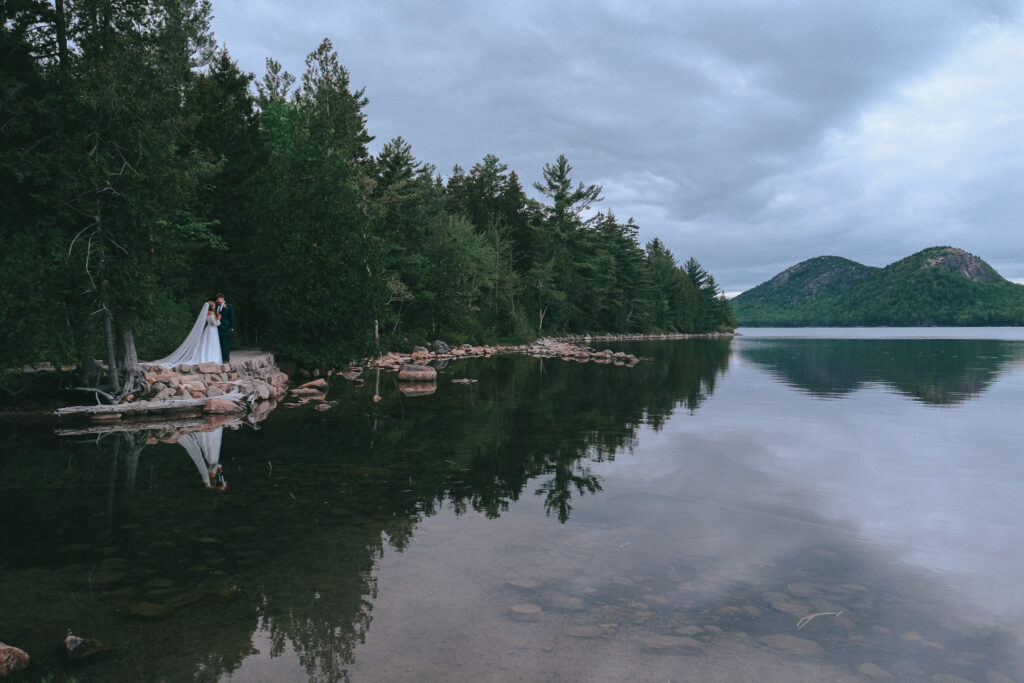
Parts of Jordan Pond can be a great option.
The area around Jordan Pond House and the boat launch is much easier to access than the full Jordan Pond Path.
The path itself includes uneven footing, roots, rocks, stepping stones, bridges, and narrow boardwalk sections.
So when someone says, “My parents can do Jordan Pond,” I still want to know what that actually means.
They may be totally comfortable joining us near the southern end of the pond for your ceremony and portraits and then heading out while we continue exploring.
That is a perfectly good plan.
How I can help:
I can help you choose the specific area of Jordan Pond that makes the most sense for your guests and plan where they join us, where we take family photos, and where they can peel off before we continue farther along the trail.
Is Ocean Path Accessible for Elopement Guests?
Ocean Path is another place where the answer depends on which section we’re talking about.
The stretch between the upper Sand Beach parking area and Thunder Hole is easier and more accessible than areas farther toward Otter Point.
As you continue, the terrain becomes more uneven and includes granite stairs in some areas.
That gives us options.
Guests might join us for part of Ocean Path, then head back while you two continue farther along the coast.
How I can help:
I can help you choose which section makes sense for your group rather than treating all of Ocean Path as one experience. We can use an easier section for guests and save the rockier areas for your couple portraits afterward.
Is Sand Beach Accessible for Elopement Guests?
The upper area and facilities are one thing. Getting down to the beach itself is another.
Sand Beach is reached by stairs, so it may not work for someone using a wheelchair or anyone who has significant difficulty with stairs.
This is a good example of why Instagram photos only tell part of the story.
The beach looks easy because you’re looking at the beach.
You’re not looking at how everyone gets there.
How I can help:
If Sand Beach itself isn’t a good fit, I can help you find another nearby location that gives you a similar coastal feel without asking guests to navigate the stairs. You can also still visit Sand Beach later with just the two of you.
Are Jesup Path and Hemlock Path Accessible?
Jesup and Hemlock Paths can be good options when we want gentler terrain.
There are sections with asphalt, packed gravel, and wooden boardwalk, and much of the route is relatively level.
That said, the boardwalk is narrow in places, so we still need to think about the individual person and any mobility equipment they use.
Again, accessibility isn’t one-size-fits-all.
How I can help:
I can help you decide whether these paths fit the specific mobility needs of your guests and which portions make the most sense. They can be really helpful when we want something that still feels very Acadia without requiring more difficult terrain.
Is Cadillac Mountain Accessible for Elopement Guests?
Yes, there are portions of the summit area that can work very well for guests who aren’t up for hiking.
You can drive to the summit area with the proper vehicle reservation when reservations are required, and there are paved sections, parking, and restrooms.
Other parts of the summit loop are steeper or include stairs, so we still have to choose the exact area with your guests in mind.
You can absolutely give someone the Cadillac Mountain experience without asking them to hike Cadillac Mountain.
How I can help:
I can help you plan which part of the summit works best for your guests and account for parking, reservations, walking distance, and timing. We can also keep guest portraits close to the easier areas and explore farther afterward.
What Mobility Concerns Should Couples Consider When Planning an Acadia Elopement?
When I ask about mobility, I’m not just asking whether someone uses a wheelchair.
Please tell me if someone:
- uses a cane, walker, wheelchair, or mobility scooter
- has trouble with stairs
- has knee, hip, ankle, or back problems
- gets winded easily
- has balance concerns
- can’t stand for long periods
- needs frequent places to sit
- is recovering from an injury or surgery
- is pregnant and may need an easier route
- has trouble walking on uneven ground
Someone can be completely independent in their normal day-to-day life and still have a hard time in Acadia.
That’s not a problem.
I just need to know so I can plan around it.
How I can help:
You don’t need to know which location solves every mobility concern before you tell me about it. Just give me the information. I can take those needs into account when I’m building location suggestions, walking routes, timelines, and backup options.
What Should You Ask Guests Before Choosing Your Acadia Elopement Locations?
Please don’t just ask, “Are you okay walking a little?”
Your parents and grandparents love you. They’re probably going to say yes because they don’t want to be the reason you change your plans.
Give them the actual details instead.
Ask things like:
“Would you be okay walking for about fifteen minutes over uneven rocks and gravel?”
“Are stairs okay if there isn’t a handrail?”
“Would standing for twenty or thirty minutes be uncomfortable?”
“Would walking before sunrise with a headlamp be difficult?”
“Do you need easy bathroom access?”
“Would having somewhere to sit nearby make a big difference?”
Those answers are actually useful.
“Don’t worry about me, honey” is very sweet.
It is not a mobility assessment.
How I can help:
If you aren’t sure what to ask a guest, send me a message. Once I know which locations we’re considering, I can give you the exact questions that matter for that particular part of the day.
Do Guests Need to Attend the Entire Acadia National Park Elopement?
No. And most of the time, I don’t think they should.
You can have a four-, six-, or eight-hour elopement without bringing every guest to every location.
A lot of my favorite timelines include a guest portion and a couple-only portion.
Your guests might join us for your ceremony, family photos, champagne, breakfast, cake, or a short scenic walk.
Then they can head back to Bar Harbor, grab lunch, go shopping, take a nap, or do whatever they want while you two keep exploring with me.
That gives everyone the best version of the day.
Your guests are there for the meaningful moments without being dragged through the park for six hours, and you still get time to hike, explore the coast, have private vows, or head somewhere more adventurous.
It also gives you some time alone together, which is never a bad thing on your wedding day.
How I can help:
This is where timeline planning can make a huge difference. I can help you decide which parts of the day make sense to include guests in, where they can comfortably leave the group, and how we transition into the couple-only portion without it feeling abrupt or overly scheduled.
Can We Choose an Accessible Ceremony Location and Still Have Adventurous Photos?
Absolutely.
Your ceremony location does not need to be the most adventurous location of the day.
We can choose somewhere that works well for your guests, take family photos, celebrate together, and then send everyone off.
After that, you two can change shoes, grab your stuff, and head somewhere completely different with me.
Your dad having a bad knee doesn’t mean you can’t hike.
Your grandmother using a cane doesn’t mean you can’t explore the coast.
A guest using a wheelchair doesn’t mean every part of your day needs to happen next to a parking lot.
We can build different pieces of the day around different people.
That flexibility is one of the best parts of having an elopement.
How I can help:
When I build your location options, I can intentionally pair an easier ceremony location with a more adventurous portrait location. You don’t need one spot to do everything, and you definitely don’t need to sacrifice the experience you want in order to take care of your guests.
What Should Guests Pack for an Acadia National Park Elopement?
I’d rather everyone bring a few things they never touch than spend the day wishing they had them.
I recommend guests bring comfortable shoes with traction, extra layers, a rain jacket, water, sunscreen, bug spray, any medications they need, and a headlamp if we’re meeting before sunrise or staying out after dark.
If someone normally uses a mobility aid, they should bring it.
Please do not leave the cane in the car because someone thinks it won’t look good in photos.
Safety comes first. Always.
How I can help:
Once your locations and timeline are finalized, I can help you create a much more specific packing list for your guests based on the season, time of day, terrain, and how long they’ll actually be with us.
When Should We Tell Our Photographer About a Guest’s Accessibility Needs?
As early as you can.
Please don’t wait until the week of your elopement to mention that Dad can’t do stairs or Grandma needs somewhere to sit every ten minutes.
Those details can completely change which locations I recommend.
Tell me during planning.
Tell me if someone walks slowly.
Tell me if they have a bad knee.
Tell me if they need close bathroom access.
Tell me if they use a wheelchair or walker.
Even if you’re not sure whether it matters, tell me anyway.
I’d much rather have too much information than discover something important once we’re already in the park.
How I can help:
You never need to come to me with a perfectly worded explanation or a medical breakdown. Something as simple as “My mom struggles with stairs and needs somewhere to sit every so often” is enough to start the conversation. From there, I can ask the questions I need to build the right plan.
Can You Have an Adventurous Acadia Elopement With Guests Who Have Limited Mobility?
Yes. Completely.
Having guests with physical limitations does not mean your elopement needs to become less adventurous.
It just means we stop treating the day like one giant group outing.
Your guests can be there for the ceremony, vows, family photos, hugs, champagne, breakfast, or whatever moments matter most to you.
Then they can go enjoy their day while you two head out for the more adventurous part.
That isn’t leaving them out.
It’s taking care of them.
Your 75-year-old dad does not need to scramble across wet granite to prove he’s excited you’re getting married. Grandma does not need to hike three miles. Your best friend does not need to ruin her ankles because she wore the wrong shoes.
And you do not need to give up the locations you love because the people you love have different abilities.
We can make room for both.
That’s the whole point of planning this intentionally.
How I can help:
My job is not just to show up with a camera after you’ve figured all of this out. I can help you build a day that takes your guests’ needs seriously while still protecting the experience you want for yourselves. We can look at locations, terrain, timing, weather, transportation, guest participation, and backup plans together so you’re not trying to solve all of those pieces on your own.
I especially like adding these because they quietly reinforce why having an Acadia-specific photographer/planning support matters without turning the whole article into “hire me, hire me, hire me.” It keeps the emphasis on helping them make better decisions.
Important Links:


